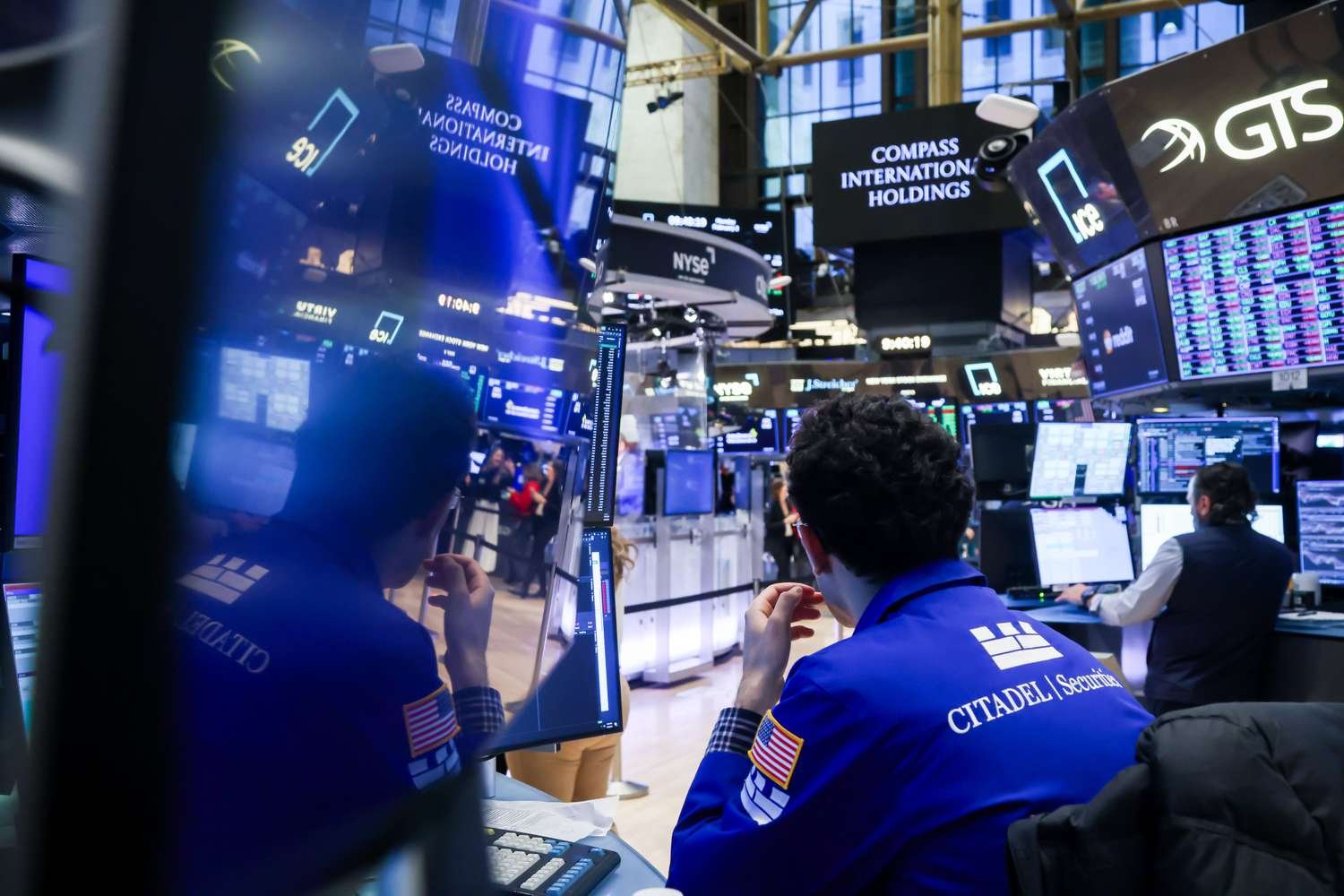
Major U.S. stock indexes closed higher for a second consecutive session on Tuesday, as investors remained focused on geopolitical tensions in the Middle East and the commencement of a two-day policy meeting by the Federal Reserve.
The technology-heavy Nasdaq rose 0.5%, while the S&P 500 gained 0.3% and the Dow Jones Industrial Average edged up 0.1%. The positive momentum follows strong gains at the start of the week, supported by a temporary decline in oil prices after their recent surge triggered by escalating conflict in the Middle East.
Oil prices, however, resumed their upward trend during the session. U.S. benchmark West Texas Intermediate (WTI) crude increased by 2.7% to approximately $96 per barrel, while Brent crude, the global benchmark, settled near $103.50 per barrel. The rise reflects mounting concerns over supply disruptions, particularly surrounding the Strait of Hormuz, a critical shipping route responsible for roughly 20% of global crude flows.
Tensions intensified after some U.S. allies declined to support efforts to reopen the Strait, while Iran issued threats against vessels attempting to pass through the region. As a result, tanker traffic has declined significantly, contributing to the surge in oil prices. Additional geopolitical uncertainty followed reports of Israeli airstrikes targeting senior Iranian leadership.
In the bond market, the yield on the 10-year U.S. Treasury note declined slightly to 4.20%, down from above 4.22% in the previous session. Investors are widely expecting the Federal Reserve to keep interest rates unchanged, adopting a cautious, wait-and-see stance amid uncertainty over the economic impact of the ongoing conflict and energy market volatility.
Market analysts suggest that the trajectory of the conflict will play a key role in shaping future monetary policy. A short-lived conflict could allow for potential interest rate cuts later in the year, whereas prolonged instability may lead the Federal Reserve to maintain its current policy stance for an extended period.
In commodities, gold prices edged higher to just above $5,000 per ounce, reflecting continued demand for safe-haven assets, while silver prices declined by 1.7% to $79.25 per ounce. The U.S. Dollar Index weakened slightly to 99.58, indicating softer demand for the currency. Meanwhile, Bitcoin traded higher at approximately $74,600, recovering from overnight lows.
Equity performance among major technology companies was mixed. Nvidia shares declined by 0.7%, despite strong attention surrounding its ongoing GPU Technology Conference. During the event, CEO Jensen Huang projected that the company’s next-generation AI systems, including Blackwell and Vera Rubin, could generate up to $1 trillion in revenue by 2027.
Nvidia also announced multiple collaborations in the autonomous vehicle space, including an expanded partnership with Uber Technologies, which drove Uber’s shares up by more than 4%.
In the airline sector, Delta Air Lines outperformed, with its shares surging 6.5% after the company raised its revenue outlook while maintaining its profit forecast despite rising fuel costs. Shares of American Airlines Group and United Airlines Holdings also gained more than 3%, reflecting broader strength across the aviation industry.
Overall, market sentiment remains cautiously optimistic, supported by corporate developments and continued momentum in artificial intelligence, but tempered by geopolitical risks and uncertainty surrounding future monetary policy.
Nvidia Forecasts $1 Trillion in Chip Sales. Can Jensen Huang’s Outlook Reignite AI Stocks?
AI is back in the Wall Street spotlight.
Amid a week crowded with headline-grabbing developments—from the conflict in Iran to the Federal Reserve’s policy meeting—investor attention has been firmly drawn to Nvidia (NVDA). The focus centers on CEO Jensen Huang, who projected unprecedented growth in the company’s data center business.
Speaking at an event on Monday, Huang forecast that sales from Nvidia’s next-generation AI systems, including Vera Rubin and Blackwell, are expected to exceed $1 trillion over the next two years. This represents a significant upward revision from the company’s previous projection of $500 billion in combined sales for 2025 and 2026. According to Huang, demand for Nvidia’s hardware and software solutions remains “off the charts,” underscoring the continued strength of the AI and data center market.
:max_bytes(150000):strip_icc():format(webp)/GettyImages-2266458892-6e1b1e3d63d34699b37b2173d1e77142.jpg)
“This was a much needed confidence boost for tech investors navigating a very tricky tape,” wrote Wedbush analyst and Nvidia bull Dan Ives Monday evening. Huang’s outlook, Ives wrote, indicates that “the AI Revolution is accelerating, not decelerating, despite the market noise.”